Tag: disaster

Strengthening disaster preparedness: SM makes the Incident Command System possible

SM Supermalls conducts Incident Command System workshops to strengthen emergency response through structure, coordination, and accountability.

In a country like the Philippines, where typhoons, earthquakes, and other natural calamities are part of the norm, resilience is not just a necessity but a way of life. Ranked consistently high in the World Risk Index due to its location along the Pacific Ring of Fire and the typhoon belt, the nation faces challenges that demand coordinated, forward-thinking approaches to disaster preparedness and response. 

Among those leading the way is SM Supermalls, whose commitment to resilience continues to evolve through investments in systems that safeguard not only business continuity but, more importantly, the communities they serve.

Disaster resilience in the private sector has become increasingly crucial. Corporations have the capacity to create ripple effects both in terms of operational continuity and their influence on surrounding communities. For SM, a sustained and risk-informed approach to resilience ensures that when emergencies strike, response is swift, coordinated, and grounded in tested protocols.

A key initiative in this approach is the company’s very own rollout of the Incident Command System (ICS). Designed to provide a standardized structure for managing emergency response, the ICS originated in the United States and is widely recognized as an on-scene, all-hazard incident management concept. Through its unified hierarchy and clearly defined roles, the ICS ensures that different responders—from government agencies to private security teams—can act in sync. This leads to more efficient resource management, better communication, and a higher degree of accountability during high-pressure situations.

As part of the initiative, SM regularly implements emergency preparedness drills across its network of malls and consistently participates in nationwide efforts for disaster preparedness, such as the annual fire and earthquake drills led by the Bureau of Fire Protection (BFP). These efforts are complemented by support for the quarterly Nationwide Simultaneous Earthquake Drills led by the Office of Civil Defense (OCD) and the National Disaster Risk Reduction and Management Council (NDRRMC). These exercises include both employees and tenants, creating a culture of readiness that extends beyond corporate boundaries.

In addition, 79 SM Supermalls have been certified under the Business Continuity Management Systems—a reflection of the company’s structured and systematized approach to disaster risk reduction and recovery. This level of certification not only reflects internal diligence but also sets a benchmark for the broader business sector.

SM also has a dedicated resilience center, which operates as a centralized communications hub during large-scale disruptions. This facility coordinates with all SM malls to ensure rapid information flow and streamlined decision-making in the event of a national emergency.

SM’s collaborative approach to disaster resilience was also demonstrated during the 2024 Asia- Pacific Ministerial Conference on Disaster Risk Reduction in Manila. On the last day of the conference, SM City Clark became the focal point of an ICS demonstration attended by the United Nations Office for Disaster Risk Resilience and foreign delegates.

The event showcased a unified response involving mall management, the Clark and Angeles municipalities, the BFP, OCD Region 3, and NDRRMC. Together, they enacted coordinated procedures designed to enhance public safety, offering an up-close look at how integrated disaster response works in a real-world environment.

In preparation for the site visit, SM Supermalls partnered with ARISE Philippines, the Private Sector Alliance for Resilient Societies, to conduct an ICS workshop alongside the OCD. This training brought together heads of operations, human resources, security, and Information Technology from SM City Clark and nearby locators such as Park Inn Hotel. Facilitated by experts from the BFP and the Philippine Army, the workshop provided hands-on training in ICS protocol, further reinforcing the company’s commitment to capacity-building at the local level.
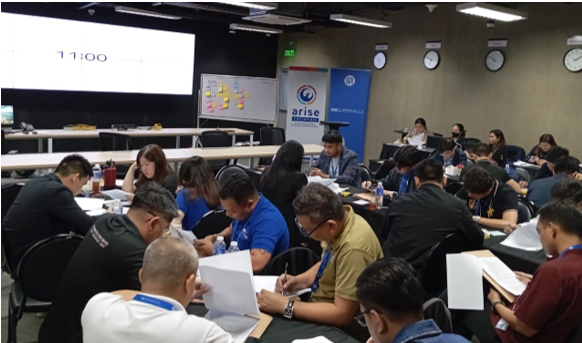
Participants of the Incident Command System workshop learn the chain of command and roles essential for managing emergencies.
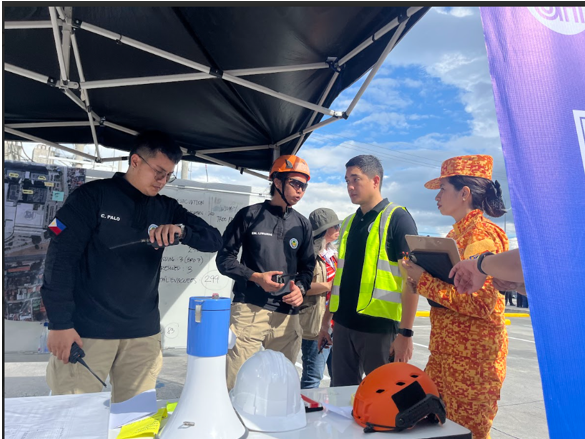
The Incident Command System is showcased in an emergency simulation at SM City Clark during the Asia-Pacific Ministerial Conference on Disaster Risk Reduction.
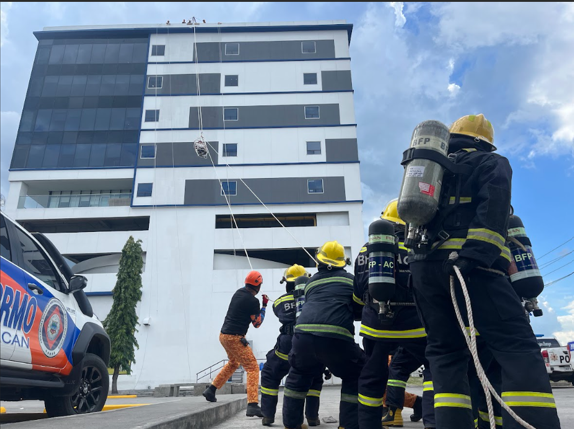
Public and private sector teams implement the Incident Command System as the Bureau of Fire Protection showcases high-angle rescue at SM City Clark.

SM’s vision for resilience is expansive and continuous. Following the success of the Clark initiative, the company is now preparing to roll out the next phase of ICS workshops, beginning with SM Mall of Asia and expanding to regional malls across the country. This nationwide implementation reflects a long-term strategy that prioritizes safety, community cohesion, and operational readiness.

“By investing in frameworks like the ICS, SM Supermalls demonstrates that resilience is not a reactive measure but an ongoing commitment,” said SM Supermalls Vice President Engr. Liza Silerio. “In a landscape defined by environmental vulnerability, this commitment provides not only peace of mind but a tangible sense of preparedness for employees, tenants, and the public at large.”

Through proactive strategies and sustained partnerships with government and civil society, SM is building more than safe spaces. It is also cultivating a culture of resilience that empowers people and protects communities in the face of any uncertainty, reiterating its commitment to promoting a more disaster-ready Philippines.

SM Mall of Asia Complex: A benchmark in resilience and innovation

The SM Mall of Asia (MOA) Complex, a 67-hectare landmark along Manila Bay, showcases SM Prime Holdings’ commitment to leveraging technology and innovation for disaster resilience and community protection for all its projects.

Initially conceived as a pioneering mixed-use development on reclaimed land spearheaded by the Philippine government, it has evolved into a benchmark of safety and stability, fulfilling the vision of founder Henry Sy, Sr., who aspired to create “a destination that brings joy and opportunities to millions.”

Expanding on his father’s vision, Hans Sy, SM Prime Executive Committee Chairman and co-chair of ARISE Philippines under the United Nations Office of Disaster Risk Resilience (UNDRR), emphasizes the importance of creating resilient, sustainable spaces that prioritize both safety and community well-being. 

“We believe that safety is the cornerstone of thriving communities,” Mr. Sy states. In affirmation of this belief, he stands as the first Filipino elected to the UNDRR ARISE Global Board. 

Launched in 2015, ARISE Philippines is the country’s 157-member-strong premier private sector alliance united by a shared vision of a resilient and prosperous future. The organization, the first country network established by the UNDRR, aims to minimize disaster-related loss of life, ensure investments and assets are risk-informed, and build infrastructure capable of withstanding both natural and man-made hazards.

SM Prime’s commitment to resilience is evident in the very design of the MOA Complex, which incorporates cutting-edge disaster resilience features to protect against the unique challenges posed by its coastal location.

Before construction began, SM Prime engaged the expertise of Jan de Nul, a renowned Belgian coastal development company. Their extensive research and studies ensured the viability of the project, taking into account the complex interplay of land and sea. To create a resilient structure, the company conducted risk reviews in which the following components are incorporated: Identify, analyze, plan, mitigate, and monitor. This meticulous pre-engineering phase laid the groundwork for a structure, completed in 2006, that was capable of withstanding the test of time and nature.

One of the key challenges addressed was soil erosion. To combat this, the team implemented a sophisticated system of wick drains. These drains act as pathways for pore water in soft, compressible soil, effectively preventing erosion and ensuring the stability of the land. This technology, while more costly than traditional methods, provides a significantly higher degree of protection, particularly against liquefaction during seismic events.

The threat of ground liquefaction, a phenomenon where soil loses its strength and behaves like a liquid during earthquakes, was also mitigated through innovative foundation design. Driven and bored piles, combined with precise excavation methods, provide the complex with robust resistance against liquefaction and seismic activity.

Reference photo for the driven piles methodology, which protects against soil liquefaction and provides strength against earthquakes.

To protect against storm surges, a common threat in coastal areas, the complex boasts a robust seawall. This seawall, standing 4.5 meters higher than the Mean Lower Low Water (MLLW) mark, is further reinforced by a wave return feature. This inverted structure deflects high waves back towards the sea, minimizing their impact on the complex. A network of drainage channels further enhances flood prevention during storm surges. 

These features were instrumental in protecting the complex during Typhoon Pedring (international name Nesat) in 2011, as well as in all succeeding severe weather disturbances this year, where the MOA Complex emerged largely unscathed while helping nearby areas avoid being inundated by prolonged deep flooding.

The wave return feature redirects water back into the bay, providing protection from high waves.

The Mall of Asia (MOA) Complex higher seawall and elevation prevent damage to the structure from rising sea levels. (Inset) In addition, the drainage channels along the MOA Complex are wide and deep enough to fit two buses side by side, helping prevent flooding from storm surges.

The complex’s resilience extends beyond its foundation. The main road and all structures are elevated significantly above the National Building Code requirements, further minimizing the risk of flooding. Buildings are equipped with Earthquake Recording Instruments (ERI) that monitor seismic activity and provide valuable data for disaster preparedness. 

The structural integrity of the buildings themselves is also paramount. The roof deck, for instance, is designed to withstand substantial loads, ensuring it can serve as a safe refuge during emergencies. The exterior façade is concrete masonry walls with Exterior Insulation Finishing Systems (EIFS), designed to withstand wind speeds of up to 270 kph and provide excellent insulation. This commitment to safety transforms SM Supermalls like the SM MOA into havens for the community during times of crisis.

SM Prime’s dedication to disaster resilience is not merely a response to potential threats; it is a proactive strategy integrated into the DNA of all its business operations.  The company automatically allocates a significant portion of its capital expenditure to disaster resilience research and construction, recognizing that investing in safety is an investment in the future.

SM Prime’s longstanding reputation as a responsible property developer is built not only on its contributions to the country’s economic growth and the creation of dynamic lifestyle destinations, but also on its unwavering commitment to protecting the lives and livelihoods of the communities it serves. The MOA Complex stands as a powerful symbol of this commitment, a beacon of resilience in the face of natural adversity.