Tag: environment

SM Mall of Asia Complex: A benchmark in resilience and innovation

The SM Mall of Asia (MOA) Complex, a 67-hectare landmark along Manila Bay, showcases SM Prime Holdings’ commitment to leveraging technology and innovation for disaster resilience and community protection for all its projects.

Initially conceived as a pioneering mixed-use development on reclaimed land spearheaded by the Philippine government, it has evolved into a benchmark of safety and stability, fulfilling the vision of founder Henry Sy, Sr., who aspired to create “a destination that brings joy and opportunities to millions.”

Expanding on his father’s vision, Hans Sy, SM Prime Executive Committee Chairman and co-chair of ARISE Philippines under the United Nations Office of Disaster Risk Resilience (UNDRR), emphasizes the importance of creating resilient, sustainable spaces that prioritize both safety and community well-being. 

“We believe that safety is the cornerstone of thriving communities,” Mr. Sy states. In affirmation of this belief, he stands as the first Filipino elected to the UNDRR ARISE Global Board. 

Launched in 2015, ARISE Philippines is the country’s 157-member-strong premier private sector alliance united by a shared vision of a resilient and prosperous future. The organization, the first country network established by the UNDRR, aims to minimize disaster-related loss of life, ensure investments and assets are risk-informed, and build infrastructure capable of withstanding both natural and man-made hazards.

SM Prime’s commitment to resilience is evident in the very design of the MOA Complex, which incorporates cutting-edge disaster resilience features to protect against the unique challenges posed by its coastal location.

Before construction began, SM Prime engaged the expertise of Jan de Nul, a renowned Belgian coastal development company. Their extensive research and studies ensured the viability of the project, taking into account the complex interplay of land and sea. To create a resilient structure, the company conducted risk reviews in which the following components are incorporated: Identify, analyze, plan, mitigate, and monitor. This meticulous pre-engineering phase laid the groundwork for a structure, completed in 2006, that was capable of withstanding the test of time and nature.

One of the key challenges addressed was soil erosion. To combat this, the team implemented a sophisticated system of wick drains. These drains act as pathways for pore water in soft, compressible soil, effectively preventing erosion and ensuring the stability of the land. This technology, while more costly than traditional methods, provides a significantly higher degree of protection, particularly against liquefaction during seismic events.

The threat of ground liquefaction, a phenomenon where soil loses its strength and behaves like a liquid during earthquakes, was also mitigated through innovative foundation design. Driven and bored piles, combined with precise excavation methods, provide the complex with robust resistance against liquefaction and seismic activity.

Reference photo for the driven piles methodology, which protects against soil liquefaction and provides strength against earthquakes.

To protect against storm surges, a common threat in coastal areas, the complex boasts a robust seawall. This seawall, standing 4.5 meters higher than the Mean Lower Low Water (MLLW) mark, is further reinforced by a wave return feature. This inverted structure deflects high waves back towards the sea, minimizing their impact on the complex. A network of drainage channels further enhances flood prevention during storm surges. 

These features were instrumental in protecting the complex during Typhoon Pedring (international name Nesat) in 2011, as well as in all succeeding severe weather disturbances this year, where the MOA Complex emerged largely unscathed while helping nearby areas avoid being inundated by prolonged deep flooding.

The wave return feature redirects water back into the bay, providing protection from high waves.

The Mall of Asia (MOA) Complex higher seawall and elevation prevent damage to the structure from rising sea levels. (Inset) In addition, the drainage channels along the MOA Complex are wide and deep enough to fit two buses side by side, helping prevent flooding from storm surges.

The complex’s resilience extends beyond its foundation. The main road and all structures are elevated significantly above the National Building Code requirements, further minimizing the risk of flooding. Buildings are equipped with Earthquake Recording Instruments (ERI) that monitor seismic activity and provide valuable data for disaster preparedness. 

The structural integrity of the buildings themselves is also paramount. The roof deck, for instance, is designed to withstand substantial loads, ensuring it can serve as a safe refuge during emergencies. The exterior façade is concrete masonry walls with Exterior Insulation Finishing Systems (EIFS), designed to withstand wind speeds of up to 270 kph and provide excellent insulation. This commitment to safety transforms SM Supermalls like the SM MOA into havens for the community during times of crisis.

SM Prime’s dedication to disaster resilience is not merely a response to potential threats; it is a proactive strategy integrated into the DNA of all its business operations.  The company automatically allocates a significant portion of its capital expenditure to disaster resilience research and construction, recognizing that investing in safety is an investment in the future.

SM Prime’s longstanding reputation as a responsible property developer is built not only on its contributions to the country’s economic growth and the creation of dynamic lifestyle destinations, but also on its unwavering commitment to protecting the lives and livelihoods of the communities it serves. The MOA Complex stands as a powerful symbol of this commitment, a beacon of resilience in the face of natural adversity.

Building sustainable communities: The future of cities

The 7th Annual Association of Pacific Rim Universities – Sustainable Cities and Landscapes Conference and Student Symposium 2024 (APRU-SCL 2024) Conference on Advancing Sustainable Cities and Communities through Science, Technology, and Innovations is hosted and organized this year by the University of the Philippines Los Baños (UPLB). 

(L-R): Dr. Jennifer Marie S. Amparo, Dean, CHE, Dr. Jose V. Camacho, Jr. Chancellor, UPLB, Dr. Thomas Schneider, Chief Executive, APRU, Makati Mayor Hon. Abigail Binay, Ms. Jessica Bianca Sy, SMPHI and SMDC Lead Executive for Design, Innovation and Strategy, Dr. Edgar M. Reyes, Jr., Conference Director, ICHSPD, Assoc. Professor, UPLB, and Dr. Yekang Ko, Director, APRU-SCL, Assoc. Professor, University of Oregon.  

What makes a city thrive is a combination of how developers create opportunities for movement, synergy, and prosperity. It’s a combination of celebrating life to its fullest capacity with the community at its very heart. 

“At SM Prime (SMPHI), we dream big for our shared future. True prosperity transcends financial success. Our commitment to developing sustainable integrated properties is matched by our efforts to foster vibrant, inclusive communities wherever we build legacy properties that weather the challenges of time and that last for generations,” said Ms. Jessica Bianca Sy, Lead Executive for Design, Innovation and Strategy for SMPHI and SM Development Corporation (SMDC). 

Sy joins a list of esteemed local and international professors, climate specialists, and government officials at the 7th Annual Conference of the Association of Pacific Rim Universities – Sustainable Cities and Landscapes Conference and Student Symposium 2024 (APRU-SCL 2024). 

The theme for this year’s three-day conference is Advancing Sustainable Cities and Communities through Science, Technology, and Innovation. 

As one of Asia’s leading integrated property developers, SM Prime’s strong track record in sustainability and disaster resilience is central to the company’s projects. In a climate-vulnerable country like the Philippines, disaster preparedness and infrastructure resilience are priorities, with a goal to scale efforts to a city level. 

The rapid city growth increases energy demand, necessitating innovative and efficient renewable energy solutions. SM Prime has partnered with franchise holders to systematically manage energy use and move towards net-zero emissions.

For future large-scale master planned developments, Sy shares that SM Prime is taking a systems approach to utility infrastructure down to embedding them in the urban design guidelines at the precinct or plot level developments.

“We are developing this living framework together with our knowledge partners. Currently the ambition is to combine our efforts and actionable items under six themes of – transport, energy, water, biodiversity, built form and materials,” she said. 

Sy carries this clear vision to heart as an invaluable part of the path forward. “We believe this will be the future of cities in the Philippines and we are committed to delivering it to our future generations,” she said.

SM Prime remains committed to its role as a catalyst for economic growth, delivering innovative and sustainable lifestyle cities, thereby enriching the quality of life of millions of people. SM Prime is pursuing the next horizon on integrated property development and onward to building sustainable cities of the future. 

The 7th APRU-SCL 2024 is hosted and organized this year by the University of the Philippines Los Baňos, at the SMX Aura Convention Center, from August 6-8, 2024. For more information, email: hspdconf@up.edu.ph or visit the website: dcerp.che.uplb.edu.ph/ichspd.

SM Prime Embarks on a Unified Waste Management Program for an #SMWasteFreeFuture

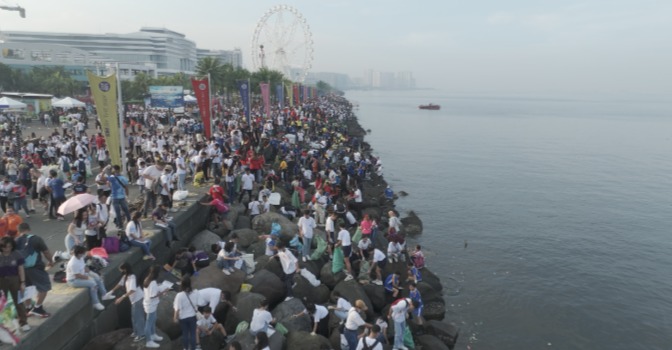
The largest haul and biggest participation to-date: The 38th International Coastal Clean-up had 17,000 volunteers across 15 SM Malls in 12 locations nationwide. It is an annual community-driven partnership between SM Supermalls, SM Cares, the DENR, LGU’s and the volunteers from the SM community.

SM Prime Holdings, Inc. (SM Prime), one of the leading integrated property developers in Southeast Asia, is embarking on a unified waste management and segregation campaign in response to the growing global crises on waste. SM Prime aims to bring all its property groups and stakeholders toward an #SMWasteFreeFuture.

According to the United Nations Environment Programme (UNEP), humanity generates more than 2 billion tons of municipal solid waste annually, of which 45 percent is mismanaged. Without urgent action, municipal solid waste will double to almost 4 billion tons each year by 2050. On December 14, 2022, the United Nations General Assembly proclaimed March 30 as the International Day of Zero Waste.

The following year, UNEP inaugurated the First International Day of Zero Waste, to bolster actions to address the global pollution crisis. It aims to encourage global action and bring the world’s attention to zero waste.

Strong foundations

SM Prime’s founding leader, Henry Sy, believed that “business growth and social development must go hand in hand.” The company follows this guiding principle and has formed a sustainability policy that commits to the following: Resource Conservation and Efficiency, Disaster Resilience, Climate Advocacy, Social Integration, and Transparent Reporting.

Anchored on these sustainability commitments are the SM Supermalls’ Environmental Programs on Waste Management. Through its corporate social responsibility arm, SM Cares, SM Supermalls has pioneered longstanding programs such as the Trash to Cash recycling market, and provided support to the annual International Coastal Clean Up, among other national events.

In the hotel and tourism sector, SM Hotels and Conventions Corporation (SMHCC) has taken the lead in mitigating global food waste by implementing sustainable initiatives across its properties in the Philippines. Their key initiatives include the World Wide Fund for Nature’s Sustainable Diner Program, that aims to transform and help the food service sector minimize its impact on the environment thru resource efficiency, plastic refusal and food waste management and contribute to the world’s future food security.

To support these programs, SM Prime also recently unveiled its waste-to-fuel partnership with GUUN Co. Ltd. (GUNN) to implement the Japanese technique of reducing landfill impact. The technology converts non-recyclable and hard-to-recycle packaging into alternative fuel.

(Photo caption) No time to waste: Sorting through the amount of trash at the GUUN Facility in Cebu. Unfit for recycling and reuse, the waste material recovered avoids the landfill and is then reconverted to fuel resource.

A Vision for an #SMWasteFreeFuture

To mark the International Day of Zero Waste on March 30, 2024, SM Prime is releasing its vision for an #SMWasteFreeFuture. “As a community, we strongly believe in our ability to contribute to solving today’s waste issues,” said Hans “Chico” Sy, Jr., President of SM Engineering Design and Development Corporation (SMEDD) and SM sustainability champion.

SM Prime’s announcement of its vision of an #SMWasteFreeFuture demonstrates the company’s strong commitment and sustainability stewardship, by inviting its stakeholders to engage in activities that will help spread zero-waste awareness and work for a sustainable and environmentally responsible approach on waste management.

“We understand that this may seem like a daunting challenge to overcome However, by joining forces, we can create a world that our future generations truly deserve – if we have the courage to take on this journey together,” said Sy.

SM Prime remains committed to its role as a catalyst for economic growth, delivering innovative and sustainable lifestyle cities, thereby enriching the quality of life of millions of people. SM Prime is pursuing the next horizon on integrated property development and onward to building sustainable cities of the future.